

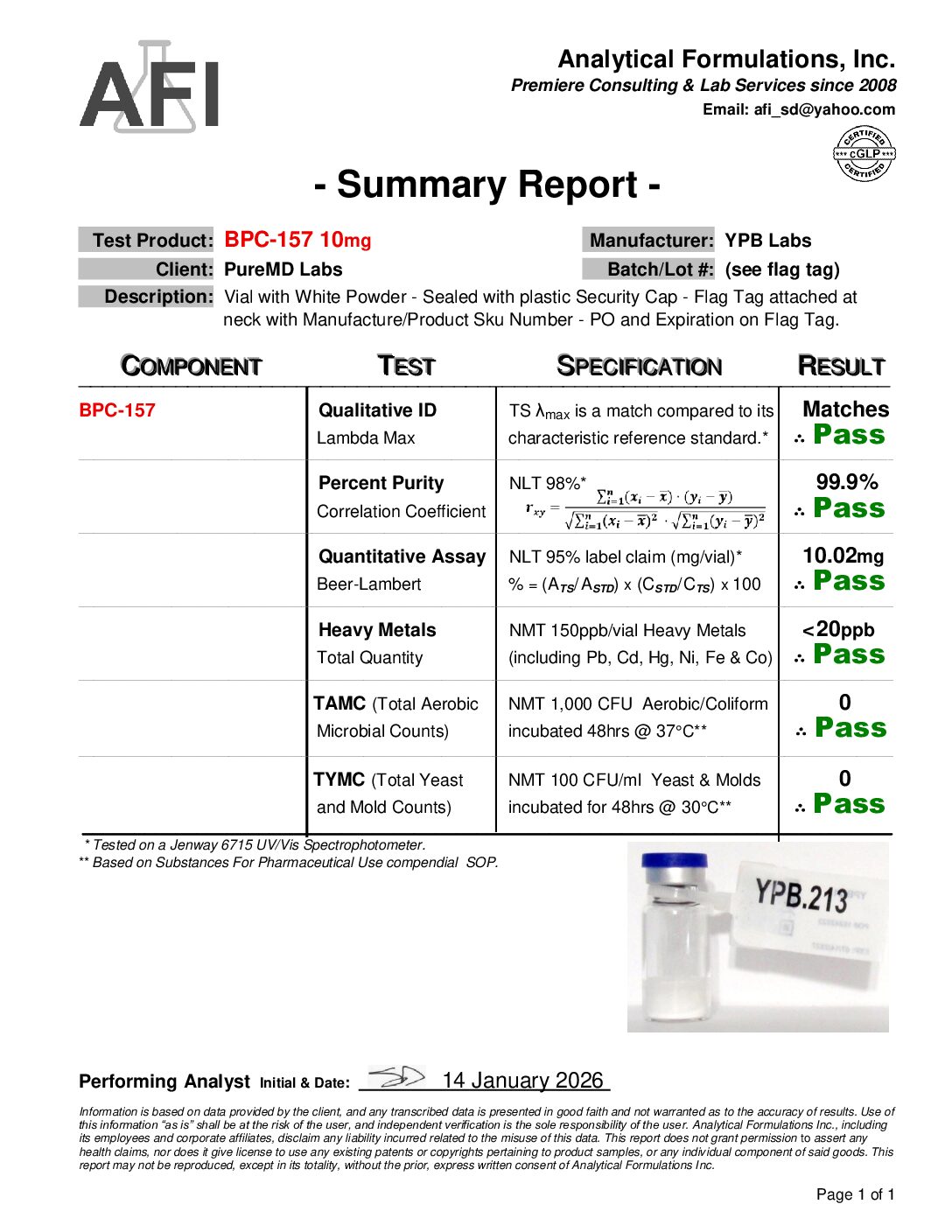
Description
BPC-157 Peptide
For Research & Laboratory Use Only
Overview
BPC-157 (Body Protection Compound-157), also known as Pentadecapeptide BPC-157, is a synthetic 15–amino-acid peptide originally derived from a naturally occurring protective protein found in gastric juice.(1)
Across experimental settings, BPC-157 has been investigated for its proposed influence on:
-
Tendon, ligament, and muscle tissue repair
-
Nerve regeneration
-
Gastrointestinal protection
-
Angiogenesis and vascular stability
-
Inflammation modulation
Studies have suggested that BPC-157 may interact with cellular pathways connected to growth factor signaling, fibroblast activation, nitric oxide regulation, and extracellular matrix formation.
Mechanistic Overview
Interaction With Growth Hormone–Linked Pathways
Preclinical research suggests BPC-157 may interact with growth-hormone–related receptors, possibly supporting:
-
Cell proliferation
-
Collagen formation
-
Angiogenesis
-
Early wound remodeling(1)
These proposed mechanisms provide a biochemical basis for its study in tissue repair and experimental regeneration models.
Serotonin & Gastrointestinal Modulation
Serotonin (5-HT) plays a key regulatory role in the gastrointestinal mucosa. Altered 5-HT levels may affect gastric acid secretion, mucosal stability, and blood flow.(2)
BPC-157 has been investigated for its potential to:
-
Counteract 5-HT2A–linked actions
-
Influence serotonin-associated responses
-
Support mucosal integrity and motility(3)
Anti-Inflammatory & Angiogenic Activity
Preclinical studies suggest BPC-157 may:
-
Increase VEGF expression
-
Promote endothelial cell migration
-
Enhance granulation tissue formation
-
Support neovascularization(6)
Additionally, its stability and compatibility in various tissue environments have prompted research into its potential role across different wound types, including GI tract lesions.(7)
Chemical Makeup
Molecular Formula: C₆₂H₉₈N₁₆O₂₂
Molecular Weight: 1419.55 g/mol
Other Names: Body Protection Compound-157, Pentadecapeptide BPC-157
Research and Experimental Findings
1. BPC-157 and Wound Healing
Multiple wound-model studies have observed increases in:
-
Collagen and reticulin fiber formation
-
Blood vessel development
-
Re-epithelialization
-
Granulation tissue formation(5,6)
Research also indicates potential modulation of:
-
ERK1/2 phosphorylation
-
c-Fos, c-Jun, and Egr-1 activity
-
HUVEC proliferation and migration(6)
These findings highlight BPC-157’s proposed angiogenic and cellular-signaling influence.
2. Tendon and Ligament Repair
In tendon fibroblast culture experiments, BPC-157 appeared to:
-
Promote tendon outgrowth
-
Enhance fibroblast migration
-
Support survival under oxidative stress
-
Increase phosphorylation of FAK and paxillin with stable total protein levels(1)
These mechanisms suggest potential involvement in cytoskeletal regulation and adhesion pathways.
3. Gastrointestinal Healing
Among growth factors such as EGF, FGF, and VEGF, BPC-157 uniquely demonstrated consistent experimental activity across:
-
Esophageal lesions
-
Gastric ulcers
-
Duodenal injuries
-
Lower GI tract wounds(7)
Its proposed angiogenic and cytoprotective activity has made it a subject of ongoing GI-focused research.
4. Systemic Tissue Protection
Additional studies have explored BPC-157’s potential actions in models of:
-
Pancreatic injury
-
Liver lesions
-
Cardiac tissue damage
-
Endothelial dysfunction
-
Blood pressure disturbances(8)
Researchers hypothesize interaction with multiple defense pathways involving dopamine, nitric oxide, prostaglandins, and somatosensory signaling.(8)
5. Muscle Regeneration
In corticosteroid-impaired muscle injury models, BPC-157 appeared to restore:
-
Gastrocnemius muscle integrity
-
Functional mobility
-
Tissue architecture(9)
Placebo groups demonstrated no comparable recovery.
6. Dopaminergic Interaction & Hypersensitivity Models
BPC-157 has been studied in amphetamine-induced and haloperidol-sensitized models:
-
Apparent reversal of amphetamine-related stereotypy
-
Near-complete reversal of haloperidol-induced supersensitivity(10)
These results suggest possible interaction with dopamine-linked pathways in experimental settings.
7. Central Nervous System & TBI Models
In traumatic brain injury models, BPC-157 exposure was associated with:
-
Reduced hemorrhagic lesion severity
-
Lower mortality
-
Decreased brain edema
-
Improved early neurological outcomes(11)
Pre-injury administration also appeared to mitigate immediate trauma effects.
Research-Use Only Disclaimer
BPC-157 from OptiBuild Peptides is supplied strictly for laboratory, scientific, and in-vitro research.
Not for human use, medical treatment, or veterinary administration.
All purchases must comply with applicable research regulations and our Terms & Conditions.
References
-
Chang, Chung-Hsun et al. The promoting effect of pentadecapeptide BPC 157 on tendon healing… J Appl Physiol. 2011.
-
Ormsbee HS III, Fondacaro JD. Action of serotonin on the gastrointestinal tract. Proc Soc Exp Biol Med. 1985.
-
Sikiric, P. et al. Brain-gut Axis and Pentadecapeptide BPC 157… Curr Neuropharmacol. 2016.
-
Krivic A., et al. Modulation of early functional recovery of Achilles tendon… Inflamm Res. 2008.
-
Seiwerth S. et al. BPC-157’s effect on healing. J Physiol Paris. 1997.
-
Huang T., et al. BPC-157 enhances alkali-burn wound healing… Drug Des Devel Ther. 2015.
-
Seiwerth S., et al. BPC-157 and Standard Angiogenic Growth Factors… Curr Pharm Des. 2018.
-
Sikiric P. Pharmacological properties of BPC 157 (PL-10). Inflammopharmacology. 1999.
-
Pevec D., et al. Impact of pentadecapeptide BPC-157 on muscle healing… Med Sci Monit. 2010.
-
Jelovac N., et al. BPC 157 blocks stereotypy produced by amphetamine… Biol Psychiatry. 1998.
-
Tudor M., et al. Traumatic brain injury in mice and pentadecapeptide BPC 157 effect. Regul Pept. 2010.
-
Gwyer D., Wragg N.M., Wilson S.L. Gastric pentadecapeptide BPC-157 in musculoskeletal healing. Cell Tissue Res. 2019.
-
Veljaca M., et al. Development of PL 14736 for inflammatory bowel disease. 2002.
-
Phase I clinical trial: Safety and pharmacokinetics of BPC-157. ClinicalTrials.gov NCT02637284.