

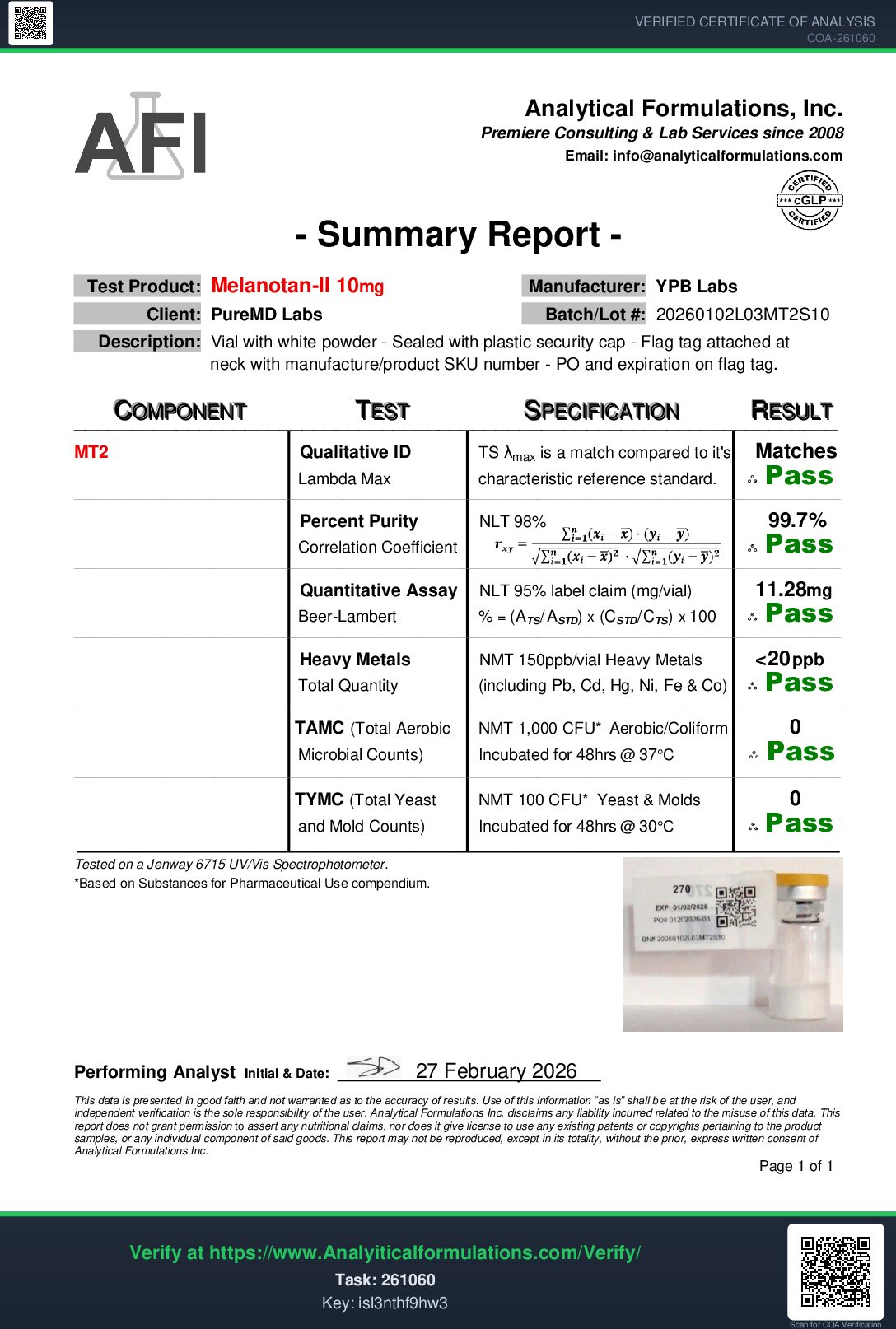
Description
Melanotan 2 (MT-II)
For Research & Laboratory Use Only
Overview
Melanotan 2 (MT-II) is a synthetic analog of α-melanocyte-stimulating hormone (α-MSH), designed as a cyclic heptapeptide with enhanced receptor affinity and metabolic stability compared to the endogenous hormone.(1)
In experimental models, Melanotan 2 has been investigated for its ability to:
-
Potentially stimulate melanogenesis (melanin production) in dermal melanocytes
-
Interact with central melanocortin receptors that may be involved in appetite regulation
-
Influence neurosignaling pathways related to various forms of arousal and sexual motivation(2,3)
Receptor Profile
Melanotan 2 is generally considered a non-selective melanocortin receptor agonist, with apparent activity at four of the five known melanocortin receptor (MC-R) subtypes.(3) Depending on tissue localization, different receptor interactions may be associated with distinct experimental outcomes.
Proposed receptor interactions include:
-
MC1R (Melanocortin 1 Receptor)
-
Primarily expressed on melanocytes in skin, hair follicles, and possibly certain ocular tissues
-
Engagement of MC1R is associated with increased eumelanin synthesis and darkening of epidermal pigment(4)
-
-
MC3R (Melanocortin 3 Receptor)
-
Found in various tissues, including regions of the brain and placenta
-
May play roles in energy balance and appetite modulation under experimental conditions
-
-
MC4R (Melanocortin 4 Receptor)
-
Located largely in the central nervous system, especially within hypothalamic regions
-
Has been linked to sexual arousal, mating behaviors, and aspects of appetite regulation(3)
-
-
MC5R (Melanocortin 5 Receptor)
-
Distributed across multiple peripheral tissues
-
Specific functional roles remain less clearly defined, but may be involved in exocrine gland function and other peripheral responses
-
For example, Melanotan 2 binding to MC1R on melanocytes has been associated with increased eumelanin production, leading to darker pigmentation of the skin in research settings.(4)
Conversely, interaction with MC4R in supraspinal centers may influence libido and sexual motivation, with downstream signaling through sympathetic and parasympathetic pathways in the spinal cord.(3)
Chemical Makeup
-
Other Known Titles: Melanotan II, MT-II
-
Molecular Weight: 1024.19 g/mol
-
Molecular Formula: C₅₀H₆₉N₁₅O₉
Research and Clinical Studies
1. Melanotan 2 and Nerve Cell Regeneration
A rodent study explored the neurotrophic and neuroprotective potential of Melanotan 2 in models of peripheral nerve injury.(5)
Key observations included:
-
Within ~48 hours of peptide exposure, Melanotan 2–treated mice exhibited improved sensory recovery compared to controls
-
When combined with a chemotherapeutic agent known to induce neuropathy (cisplatin), Melanotan 2 appeared to provide partial neuroprotection, reducing the extent of nerve toxicity(5)
These actions are thought to involve MC4R-mediated signaling, with melanocortin agonism potentially:
-
Enhancing neurite outgrowth
-
Supporting nerve sprouting and regeneration
-
Triggering intracellular cascades that may bolster neuronal resilience after injury
The authors concluded that Melanotan II “possesses neuroprotective properties” in the context of cisplatin-induced neuropathy.(5)
2. Melanotan 2 and Arousal Neuro-Signaling
Human studies have evaluated Melanotan 2 for its potential influence on sexual arousal and erectile function via central melanocortin pathways.(2,6)
In one clinical trial, Melanotan 2:
-
Was associated with increased arousal-related responses in over 80% of subjects, versus ~20% with placebo(6)
-
Appeared to act primarily through MC4R and downstream neuromodulators such as dopamine and oxytocin
These pathways are believed to converge within hypothalamic regions that coordinate:
-
Motivational states
-
Sexual behavior
-
Other homeostatic functions
Potential peripheral involvement of MC5R in exocrine glands has also been hypothesized as a secondary route linking central melanocortin signaling with peripheral modulatory effects, though this remains speculative.(3,6)
3. Melanotan 2 and Neurodevelopmental Modulation
Preclinical work has examined Melanotan 2 in neurodevelopmental and social behavior models. In a maternal immune activation (MIA) mouse model of autism, Melanotan II was explored for its capacity to influence social and behavioral features.(7)
Mechanistic hypotheses include:
-
Activation of MC4R-dependent circuits in regions such as the paraventricular nucleus (PVN) of the hypothalamus
-
Enhanced endogenous oxytocin release, potentially recalibrating networks involved in social cognition and bonding
-
Secondary modulation of serotonin, glutamate, dopamine, and GABA systems, which shape social adaptation and emotional processing
By engaging these neurochemical systems, Melanotan 2 may influence synaptic communication and plasticity across cortical and subcortical circuits (e.g., anterior cingulate cortex), potentially restoring or modifying atypical network function in animal models.(7)
4. Melanotan 2 and “Sunless Tanning” Models
Due to its robust MC1R agonism, Melanotan 2 has been studied in pigmentation research as a way to increase melanin levels independent of UV exposure.(4,8)
Findings from early-phase clinical and experimental work include:
-
Increased cutaneous pigmentation consistent with elevated eumelanin synthesis
-
Visible darkening in areas such as the face, upper body, and buttocks in research subjects(8)
-
A prolonged functional profile compared to native α-MSH, attributed in part to MT-II’s cyclic structure and enhanced receptor affinity(1,8)
These results have made Melanotan 2 a tool of interest for sunless tanning models and research into photoprotection and pigment regulation in vitro and in vivo.
Research-Use Only Disclaimer
Melanotan 2 (MT-II) from OptiBuild Peptides is intended exclusively for laboratory, scientific, and in-vitro research purposes.
It is not approved for human or veterinary use, cosmetic application, or medical treatment.
All customers must comply with our Terms and Conditions and all applicable regulations.
References
-
Ryakhovsky VV, et al. First preparative solution-phase synthesis of Melanotan II. Beilstein J Org Chem. 2008;4:39.
-
Hadley ME. Discovery that a melanocortin regulates sexual functions in humans. Peptides. 2005;26(10):1687–1689.
-
King SH, et al. Melanocortin receptors, melanotropic peptides and penile erection. Curr Top Med Chem. 2007;7(11):1098–1106.
-
Peters B, et al. Melanotan II as a possible cause of renal infarction: case report and literature review. CEN Case Rep. 2020;9(2):159–161.
-
ter Laak MP, et al. Melanotan-II promotes peripheral nerve regeneration and has neuroprotective properties in rats. Eur J Pharmacol. 2003;462(1–3):179–183.
-
Wessells H, et al. Melanocortin receptor agonists, penile erection, and sexual motivation: human studies with Melanotan II. Int J Impot Res. 2000;12 Suppl 4:S74–S79.
-
Minakova E, et al. Melanotan-II reverses autistic features in a maternal immune activation mouse model of autism. PLoS One. 2019;14(1):e0210389.
-
Dorr RT, et al. Evaluation of Melanotan-II, a superpotent cyclic melanotropic peptide, in a phase I pilot clinical study. Life Sci. 1996;58(20):1777–1784.