

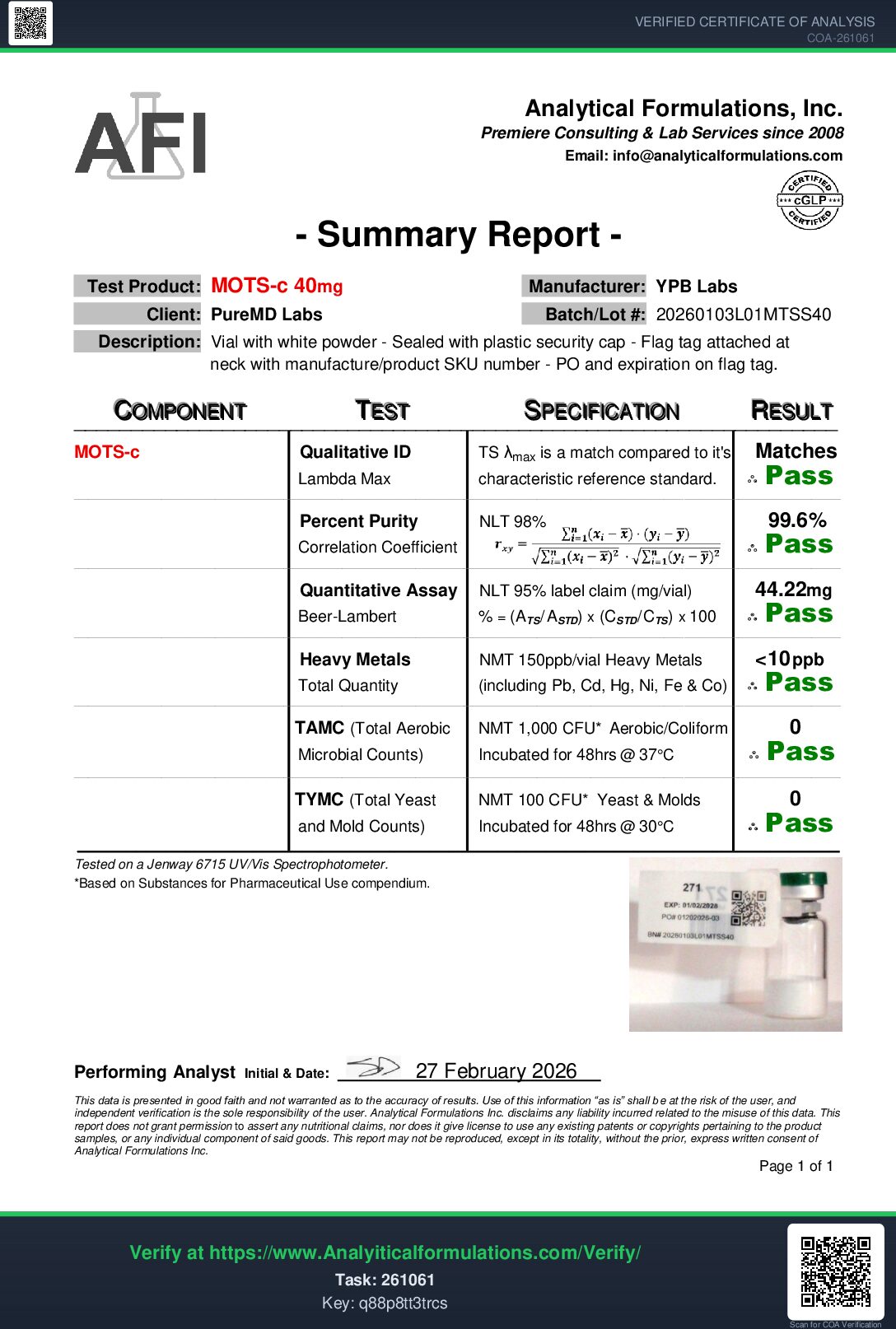
Description
MOTS-c (Mitochondrial-Derived Peptide)
For Research & Laboratory Use Only
Overview
MOTS-c (Mitochondrial Open Reading Frame of the 12S rRNA-c) is a mitochondria-derived peptide (MDP) composed of 16 amino acids. It has been detected in both tissues and plasma, suggesting a dual role as a cell-local signaling factor and a circulating hormone-like peptide.(1)
Among mitochondrial-derived peptides, only Humanin and MOTS-c have been characterized in detail to date.(2,3) MOTS-c is of particular interest because:
-
It appears to activate the AMP-activated protein kinase (AMPK) pathway
-
It may respond to metabolic stress by translocating from mitochondria to the cell nucleus
-
It may regulate nuclear gene expression in response to cellular energy status(6)
-
It can be released extracellularly and has been described as a “mitochondrial hormone” or “mitokine”(2,3)
These properties position MOTS-c at the intersection of mitochondrial signaling, metabolism, and aging biology.
Chemical Makeup(4)
-
Sequence Length: 16 amino acids
-
Molecular Formula: C₁₀₁H₁₅₂N₂₈O₂₂S₂
-
Molecular Weight: 2174.64 g/mol
-
Other Names:
-
Mitochondrial-derived peptide MOTS-c
-
Mitochondrial open reading frame of the 12S rRNA-c
-
Research and Experimental Findings
Animal and cellular models have associated MOTS-c with multiple potential actions, including:
-
Enhanced physical performance and resistance to age-related physical decline
-
Modulation of skeletal muscle and adipose tissue metabolism
-
Adaptations in myoblasts and muscle homeostasis
-
Potential involvement in cellular aging, insulin sensitivity, and nutrient sensing(1,2,5)
MOTS-c expression and circulating levels appear to decrease with age, and the peptide may interact with key regulators of longevity such as NAD+ and sirtuins, placing it within broader aging-related pathways.(1,2,4)
1. MOTS-c and Muscle Metabolism
With aging, skeletal muscle often develops insulin resistance, leading to impaired glucose uptake. Research suggests that MOTS-c can:
-
Enhance AMPK activation in skeletal muscle
-
Upregulate glucose transporter expression
-
Improve glucose uptake and fuel utilization in muscle tissue(1,3)
Beyond glucose handling, MOTS-c has been linked to:
-
Modulation of the folate–methionine cycle
-
Influence on de novo purine biosynthesis
-
Shifts in the balance between anabolic and catabolic cellular programs
As a circulating mitokine, MOTS-c may function hormonally to coordinate systemic metabolic responses across skeletal muscle and potentially adipose tissue, integrating energy balance, insulin responsiveness, and nutrient status.(1,3,5)
2. MOTS-c and Fat Cell / Whole-Body Metabolism
One prominent hypothesis is that MOTS-c leaves the mitochondria under metabolic stress and translocates to the nucleus, where it may:
-
Bind promoters enriched with antioxidant response elements (AREs)
-
Interface with stress-sensitive transcription factors such as NRF2
-
Participate in mito–nuclear communication, where mitochondrial signals regulate nuclear gene expression(6)
In a high-fat diet mouse study, only half the animals were given MOTS-c. In MOTS-c–treated mice, researchers observed:
-
Inhibition of the folate cycle, which is coupled to purine biosynthesis
-
Subsequent AMPK activation
-
Improved insulin sensitivity and metabolic homeostasis(3)
These changes were linked to:
-
Increased glucose utilization
-
Adjustments in methionine–folate cycle activity
-
Altered lipid handling and resistance to diet-induced obesity
MOTS-c–exposed mice were reported to be leaner and more active, suggesting potential roles in preventing fat accumulation and insulin resistance via AMPK-driven pathways.(3,4)
In ovariectomized models of metabolic dysfunction, MOTS-c also appeared to help maintain adipose homeostasis and prevent estrogen-deficiency–related metabolic decline.(4)
3. MOTS-c and Bone Metabolism
Preclinical work suggests that MOTS-c may influence bone formation and remodeling, primarily through the TGF-β/Smad signaling pathway.(7)
Reported effects in bone marrow–derived mesenchymal stem cells include:
-
Upregulation of TGF-β1, TGF-β2, and Smad7
-
Enhanced expression of osteogenic markers such as:
-
ALP (alkaline phosphatase)
-
Bglap (osteocalcin)
-
Runx2
-
When TGF-β1 was knocked down, the MOTS-c–induced osteogenic differentiation was diminished, suggesting that its actions are at least partially dependent on the TGF-β/Smad axis.(7)
These findings indicate that MOTS-c may support:
-
Osteoblast differentiation
-
Improved bone density and structural integrity in experimental models
4. MOTS-c and Vascular / Cardiac-Related Function
Current evidence does not strongly support a direct inotropic or chronotropic effect of MOTS-c on the heart itself. Instead, its potential relevance appears to be at the level of the endothelium:
-
Studies have found a positive association between circulating MOTS-c levels and both microvascular and epicardial endothelial function.(8)
-
Lower MOTS-c levels were reported in patients with coronary endothelial dysfunction, suggesting a potential biomarker role.(8)
In mouse models, MOTS-c exposure seemed to:
-
Improve endothelial performance
-
Potentially ameliorate vascular dysfunction, possibly via AMPK activation(8)
These data hint that MOTS-c may contribute to maintaining vascular health, particularly in the context of metabolic or coronary endothelial disturbances.
5. MOTS-c and Cellular Lifespan / Longevity
MOTS-c is of interest in longevity research because of its:
-
Mitochondrial origin
-
Interaction with canonical aging pathways (NAD+, sirtuins, AMPK)(1,2,4,9)
-
Hormone-like signaling behavior (“mitokine”)
One aspect under investigation is a naturally occurring polymorphism where a glutamate (E) residue in the MOTS-c sequence is replaced by lysine (K). While glutamate and lysine differ significantly in charge and chemical properties, the exact functional consequence of this substitution remains unclear.
Noriyuki Fuku et al. proposed a potential link between MOTS-c variants and exceptional longevity, speculating that:
“There is a biological link between MOTS-c and extended lifespan through the putative endocrine action of this mitokine. Further mechanistic research is needed to determine the functional significance of [this] polymorphism and the potential influence of MOTS-c in the aging process.”(9)
Taken together, these findings suggest MOTS-c may participate in cellular stress resistance, metabolic resilience, and potentially lifespan modulation, warranting further mechanistic research.
Research-Use Only Disclaimer
MOTS-c from OptiBuild Peptides is supplied strictly for scientific, laboratory, and in-vitro research purposes only.
It is not intended for human or veterinary use, medical treatment, or diagnostic procedures.
All purchasers must comply with our Terms and Conditions and all applicable regulations.
References
-
Lee C, Kim KH, Cohen P. MOTS-c: A novel mitochondrial-derived peptide regulating muscle and fat metabolism. Free Radic Biol Med. 2016;100:182–187.
-
Mohtashami Z, et al. Mitochondrial-derived peptides in human aging and age-related diseases. Int J Mol Sci. 2022;23(19):11991.
-
Lee C, et al. MOTS-c promotes metabolic homeostasis and reduces obesity and insulin resistance. Cell Metab. 2015;21(3):443–454.
-
Lu H, et al. MOTS-c regulates adipose homeostasis to prevent ovariectomy-induced metabolic dysfunction. J Mol Med. 2019;97(4):473–485.
-
Reynolds JC, et al. MOTS-c is an exercise-induced mitochondrial-encoded regulator of age-dependent physical decline and muscle homeostasis. Nat Commun. 2021;12:470.
-
Kim KH, Son JM, Benayoun BA, Lee C. MOTS-c translocates to the nucleus to regulate nuclear gene expression in response to metabolic stress. Cell Metab. 2018;28(3):516–524.e7.
-
Hu BT, Chen WZ. MOTS-c improves osteoporosis via TGF-β/Smad–mediated osteogenic differentiation. Eur Rev Med Pharmacol Sci. 2018;22(21):7156–7163.
-
Qin Q, et al. Downregulation of circulating MOTS-c in patients with coronary endothelial dysfunction. Int J Cardiol. 2018;254:23–27.
-
Fuku N, et al. The mitochondrial-derived peptide: A player in exceptional longevity? Aging Cell. (doi:10.1111/acel.12389).