

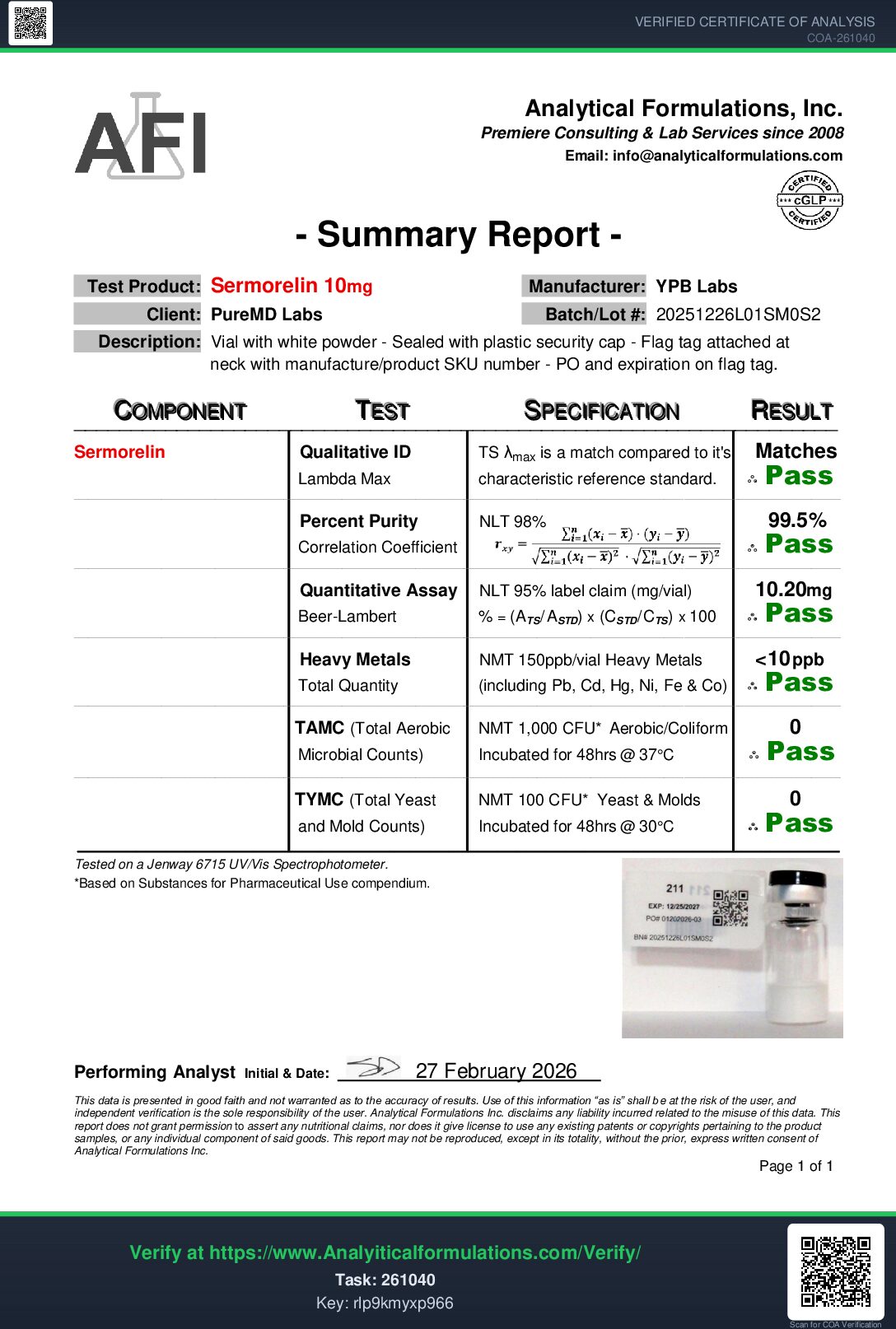
Description
Sermorelin (GRF 1-29)
For Research & Laboratory Use Only
Overview
Sermorelin is a synthetic 29–amino acid peptide corresponding to the first 29 residues of endogenous growth hormone–releasing hormone (GHRH).(2) This fragment—GHRH (1–29)-amide—represents the shortest sequence capable of activating the GHRH receptor while retaining full biological functionality. Because of this structural mimicry, Sermorelin has been studied extensively in experimental models involving growth hormone (GH) signaling and GH deficiency.(3)
Initial research in the early 1980s evaluated the activity of GHRH (1–29) fragments in both conscious and anesthetized rats. These studies demonstrated that presentation of the peptide stimulated the pituitary gland and increased growth, prompting decades of additional research into Sermorelin’s potential roles in GH regulation.(4)
Mechanistic Background
Sermorelin is an analog of native GHRH but consists only of the biologically active 1–29 fragment—sufficient to bind and activate GHRH receptors on pituitary somatotroph cells. Once bound, Sermorelin is believed to trigger pulsatile GH release, which then leads to increased circulating insulin-like growth factor-1 (IGF-1), a primary mediator of GH-dependent anabolic processes.
Although truncated, Sermorelin appears to maintain the essential GH-releasing activity of the full-length 44–amino acid GHRH molecule. The estimated biological half-life of Sermorelin is approximately 11–12 minutes, consistent with its classification as a rapid-acting GHRH analog.
An additional point often highlighted in research is Sermorelin’s theorized receptor specificity: unlike broader-acting growth hormone secretagogues, Sermorelin does not appear to significantly alter levels of cortisol, prolactin, glucose, insulin, or thyroid hormones in experimental conditions.(6)
Chemical Makeup
-
Molecular Formula: C₁₄₉H₂₄₆N₄₄O₄₂S
-
Molecular Weight: 3357.93 g/mol
-
Other Names: GRF 1-29, Sermorelin Acetate
Research and Experimental Findings
1. Sermorelin and GHRH Receptor Signaling
Sermorelin is believed to bind GHRH receptors and initiate intracellular signaling cascades involving adenylate cyclase activation, increased cyclic AMP (cAMP) accumulation, and subsequent stimulation of protein kinase A (PKA).(12) PKA activation may lead to phosphorylation of regulatory proteins that stimulate GH secretion.
This cascade ultimately promotes the release of GH from somatotroph cells and subsequent IGF-1 synthesis, contributing to anabolic activity.
2. Sermorelin and Growth Velocity
Early research involving animal models with idiopathic GH deficiency reported improvements in growth rate and height velocity over a 12-month period following consistent exposure to Sermorelin.(7) These improvements were reported to persist for up to 36 months in long-term observations.
3. Sermorelin and Anabolic Outcomes
A series of studies exploring Sermorelin’s GH-modulating potential showed:
-
~82% increase in average GH levels lasting roughly 2 hours(13)
-
107% increase in GH and ~28% increase in IGF-1 over 16 weeks(14)
-
Increases in lean body mass (LBM) of approximately 1.26 kg (2.78 lbs)
-
Increased skin thickness, suggesting connective tissue effects
These changes were not associated with significant alterations in fat mass.
4. Sermorelin and Lipodystrophy
A controlled clinical study examined Sermorelin in 31 HIV-positive subjects with lipodystrophy.(8)
Reported findings included:
-
Significant increases in GH and IGF-1
-
Increases in lean body mass
-
Reductions in abdominal visceral fat
-
Improvements in the trunk-to-lower-extremity fat ratio
-
No significant changes in insulin or glucose levels
These results suggest potential metabolic effects under specific research conditions.
5. Sermorelin and Cognitive Research
Age-related decline in GH has been hypothesized to contribute to cognitive impairment. In a study involving subjects aged 68–69, Sermorelin exposure appeared associated with improvements in cognitive performance on multiple components of the Wechsler Adult Intelligence Scale (WAIS), including IQ indices, picture arrangement, and verbal tasks.(9)
6. Sermorelin and Tumor Research
An exploratory study evaluating over 4,000 compounds in glioma models found that Sermorelin demonstrated the highest apparent sensitivity score across 1,018 test subjects.(10) Researchers suggested that this may relate to potential interactions with tumor cell cycle regulation, though the mechanisms remain under active investigation.
7. Sermorelin and Hypogonadism Models
Early investigations explored whether Sermorelin might influence reproductive-endocrine pathways. One study using alternating presentations of Sermorelin and GHRH 1-40 reported increases in FSH and LH, suggesting possible hypothalamic–pituitary–gonadal axis involvement.
A related clinical study in adult males (ages 22–33 and 60–78) found:
-
Modest, non–statistically significant increases in testosterone in older subjects
-
Nighttime GH peaks significantly higher than daytime readings across all groups(11)
Research-Use Only Disclaimer
Sermorelin from OptiBuild Peptides is intended solely for laboratory, scientific, and in-vitro research purposes.
Not for human use, therapy, or diagnostics.
All customers must follow our Terms & Conditions and all applicable regulations.
References
-
Garcia JM, Merriam GR, Kargi AY. Growth Hormone in Aging. Endotext.
-
Prakash A, Goa KL. Sermorelin in idiopathic GH deficiency. BioDrugs. 1999.
-
PubChem Compound Summary for Sermorelin (CID 16129620).
-
Clark RG, Robinson IC. Growth induced by pulsatile infusion of GHRF 1-29 amide. Nature. 1985.
-
FDA Drug Database (ApplNo 020443).
-
Junichi I, et al. GH secretagogues: history, mechanism, and development. JSCM Rapid Communications. 2020.
-
Prakash A, Goa KL. Sermorelin review. BioDrugs. 1999.
-
Koutkia P, et al. GHRH in HIV-associated lipodystrophy. JAMA. 2004.
-
Vitiello MV, et al. GHRH and cognition in older adults. Neurobiol Aging. 2006.
-
Chang Y, et al. Sermorelin as a potential therapy for recurrent glioma. Ann Transl Med. 2021.
-
Sinha DK, et al. GH secretagogues in hypogonadism and body composition. Transl Androl Urol. 2020.
-
Zhou F, et al. Structural basis for GHRH receptor activation. Nature Communications. 2020.
-
Vittone J, et al. Effects of nightly GHRH 1-29 in elderly men. Metabolism. 1997.
-
Khorram O, Laughlin GA, Yen SS. Long-term GHRH 1-29 effects in aging adults. J Clin Endocrinol Metab. 1997.